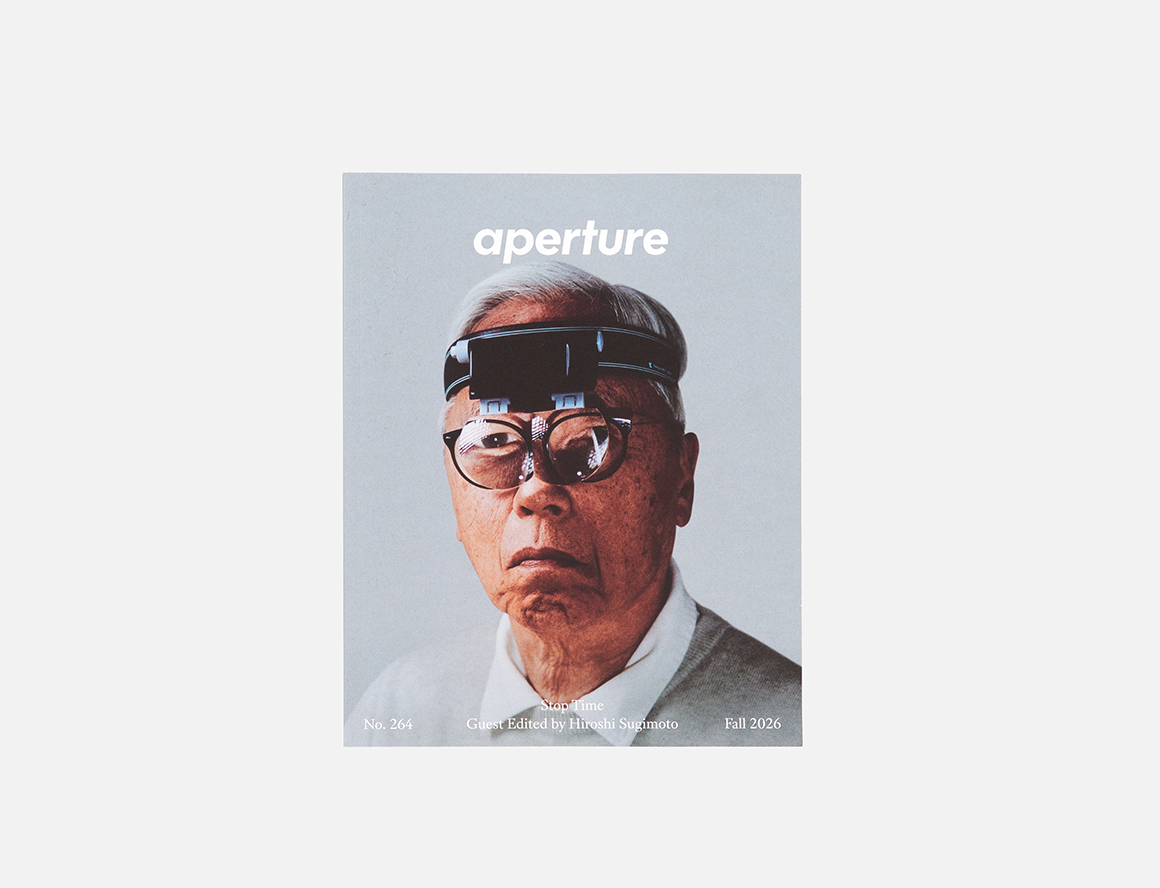
Stop Time, guest edited by Hiroshi Sugimoto: Aperture No. 264, Fall 2026
1 September 2026
A time-traveling exploration of light, vision, and photography’s deepest questions, guest edited by Hiroshi Sugimoto.
Inside, readers can also find an interview with the artist entitled "Hiroshi Sugimoto Is Playing the Long Game."
For someone who has made a career of contemplating sight, Hiroshi Sugimoto is skeptical of appearances. “All my life I have made a habit of never believing my eyes,” he once remarked.
Born in Tokyo in 1948, a son in a family of merchants, Sugimoto studied economics before deciding, in 1970, to go west—not to America, but to the Soviet Union, on a backpacking trip inspired by the utopian promises of the socialist experiment. After his travels in Eastern Europe, he moved to Los Angeles, the other end of the ideological spectrum, to study photography at Art Center. His interest in the medium had long been simmering, at least since seeing the revelatory, strange magic of a photogram in an elementary school science class. After college, Sugimoto moved to New York and sold Japanese antiques in SoHo, a business that connected him to the leading Conceptual artists of the 1970s at a time when he grappled with photography’s second-tier status within the art world. The experience deepened his fascination with old objects as markers of time, surfaces of memory and projection, and sources of aesthetic intrigue.
When we invited Sugimoto to guest edit an issue of the magazine, he responded that he’d like to focus on the impossible task of stopping time. Beneath his quiet poise, there’s a touch of the mad scientist about Sugimoto, aspiring chrononaut. His New York studio doubles as an impeccably organized cabinet of curiosities. Near a window, a large glass prism splits light into its constituent parts. A Tesla coil (when switched on) emits an antiquated crackling buzz. Dragonfly fossils dating from the Triassic period rest on a table. He is perhaps the only photographer who keeps a 400,000-volt Van de Graaff generator in his darkroom. When he’s not conducting high-voltage experiments, he enjoys the traditional tearoom he had meticulously constructed upstairs.
The large philosophical ideas that animate Sugimoto’s work are entwined with his daily life. As an artist, he has embraced typological rigor, returning to subjects over many decades—dioramas, seascapes, studies of light, waxworks, the Surrealists—to ponder the uncanny nature of representation, the indeterminacy of space-time, and the pathos and folly of humanity’s quest for immortality despite our species being a mere blip when registered in cosmic scale. His Enoura Observatory, overlooking Japan’s Sagami Bay, may be the culmination of his life’s work, showcasing his aesthetic and philosophical obsessions while allowing visitors serene environs to contemplate their own relationships to a vast sea, sky, and unknowable universe.
This all might make Sugimoto sound intensely serious, but he also projects an air of playful humor and bonhomie. The scope of his personality can be gleaned in the portraits made by Daniel Shea this past spring at his studio, where Sugimoto, ever the Renaissance man, privately played his harmonica behind a closed door during his lunch break, the muffled notes carrying throughout the space.
Read the full discussion with Michael Famighetti for Aperture here.