Ryan Gander: ‘I want things that surprise me. I want better art – Financial Times
1 September 2026
Ryan Gander can’t stop coming up with ideas for artworks. “Ghost banana,” he fires off. “A new flavour of bubblegum.” What else? “A choreographed ballet danced by construction workers.
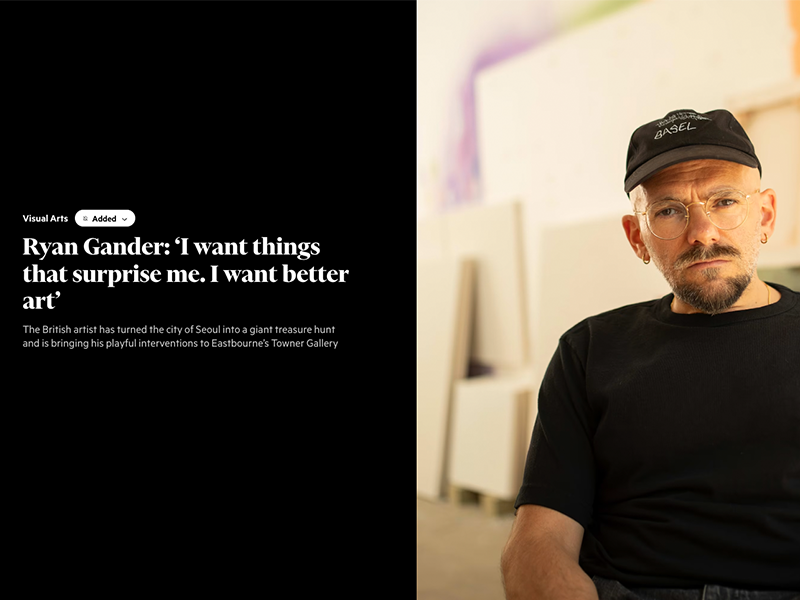
“Art could be anything at all,” he says, “so why is everyone making flat stuff with four corners that goes on the wall?” Gander speaks softly, but his takes on art are red-hot. We meet in the brutalist courtyard of London’s Barbican Centre on a scorching summer morning to discuss two upcoming shows: a citywide public art project for Frieze Seoul in September and a solo exhibition at Eastbourne’s Towner Gallery later in the autumn. Despite the fierce heat, Gander, 50, arrives in his wheelchair dressed entirely in heavy black clothes, accented by the glittering gold of his hoop earrings and round-framed glasses.
His work could rarely be described as “flat stuff with four corners that goes on the wall”. Across his wildly varied output, which encompasses painting, sculpture, installation, typography and TV documentary, he demonstrates the limitless horizons of contemporary art. His pieces defamiliarise everyday objects, offering delight, surprise and sometimes a code to be cracked. There’s the vending machine that dispenses banknotes instead of snacks; the betting shop in central Sunderland made entirely out of glass; the outdoor sculpture left deliberately unfinished, whose shape can only be completed by falling snow. Each of these works started with a few words, just like “ghost banana” or another — perhaps better — idea he has come up with on the spot: “sniffer dog looking for the curator”.
“It starts with a hypothesis or speculation,” he says. “Then you play with it.” He sticks his ideas up on the walls of his studio in the village of Melton, Suffolk, where his ex-wife and three children also live (when not travelling, Gander splits his time between there and London). He estimates that he has about 22,000 of these cards in his archives now, collated over 18 years. When it’s time for a new project, he goes to the cards and starts throwing ideas together.
“Some works I make and they’re exactly what I thought they would be. Kind of boring. That’s a failed work,” he says. “Most works change massively because of the people around me, the situations I’m in, the collisions of ideas. It’s like alchemy without making gold.” If not gold, what is the result? “It’s a contribution to human knowledge. Art should make new things that people don’t know yet. The most important thing is to surprise, to defy expectations.”
Read Ryan's full interview with Tom Faber for Financial Times here.