Olga de Amaral at Lisson Gallery – Contemporary Art Review LA
2 January 2026
Through a lifelong commitment to material experimentation, Olga de Amaral has spent more than six decades expanding the boundaries of textile art. Born in Bogotá, she first studied architecture in Colombia before finding herself in the textile design program at the Cranbrook Academy of Art in 1954, where she studied under the guidance of Marianne Strengell. This seemingly incidental career detour redirected de Amaral toward artmaking, where she uses textiles to explore the movement of bodies through space. Her sculptural, large-scale tapestries function as three-dimensional forms—often suspended from the ceiling or positioned a few inches from the wall—that invite viewers to walk cautiously around them. Traces of her early architectural training surface in her eponymous exhibition at Lisson, where she draws from the landscapes of Colombia to develop a visual language grounded in the viewer’s sensation.
An early example of de Amaral’s fascination with spatial depth is the sculpture Eslabón familiar (1973), made from locally sourced horsehair interwoven with strands of blue and orange wool. Its thick, floating rings recall a woman’s braided hair or, as the title suggests in Spanish, a chain of DNA. Placed in a corner opposite the entrance, the sculpture compels viewers to come closer. As they approach, the empty space held within each ring starts to subtly rearrange, a perceptual effect that reappears a decade later in tapestries like Paisaje de calicanto (1983). Reminiscent of damp, stone-laden valleys, vertical layers of green and orange wool stripes hang on a curtain-like rod, leaving thin slivers of white wall visible through their gaps. Like Eslabón familiar, Paisaje de calicanto is never the same work twice. It shifts with every installation and changes depending on the viewer’s position within the gallery, just as nature blooms and withers, and valleys are never the same the next day.
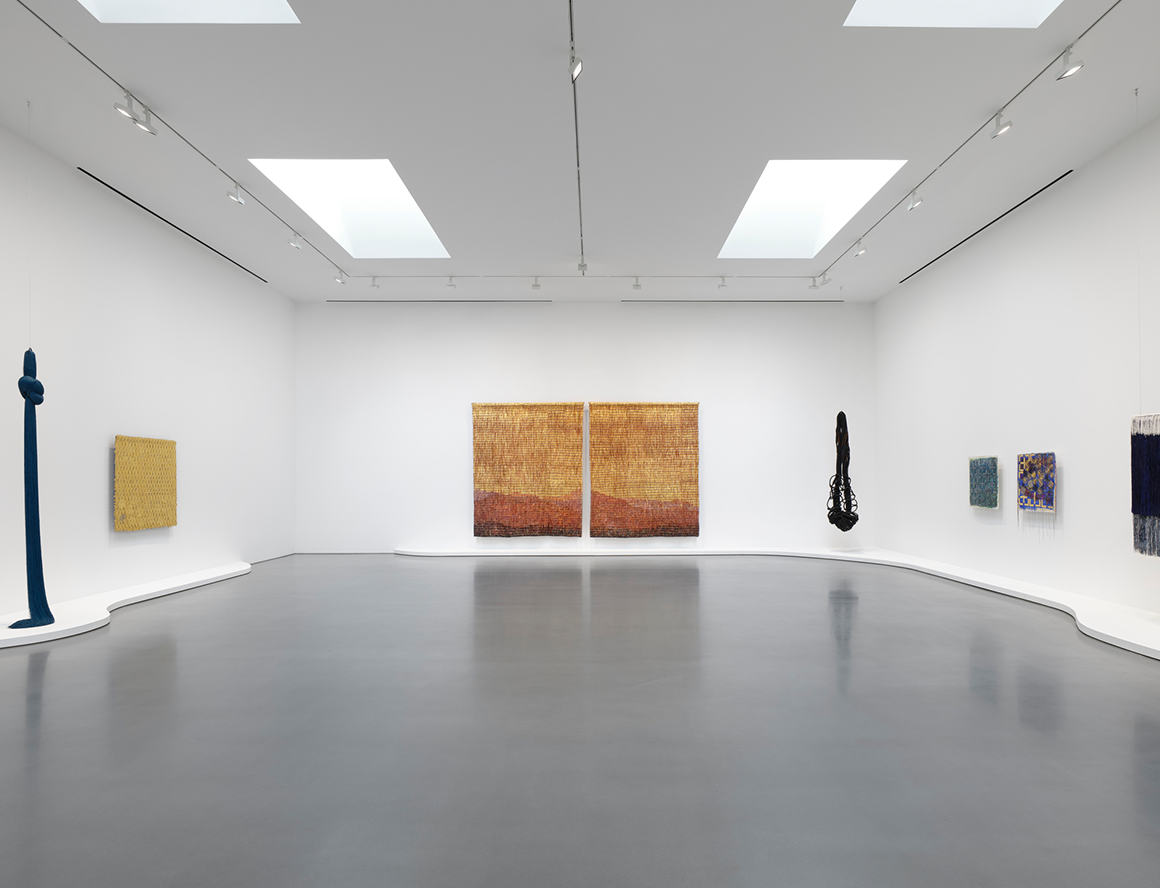
Opposite to Paisaje de calicanto hangs the diptych Alquimia 41 (díptico) [1987] created with the support of women weavers who work for de Amaral in her studio. From a distance, the two panels suggest bronze-toned mountain ranges rising against a sky of shimmering gold. Up close, the landscape dissolves into small linen squares painted with gold leaf, an approach inspired by the Japanese practice of kintsugi in which broken pottery is repaired with a mixture of lacquer and powdered gold. Nearby, Nudo 19 (turquesa) [2014] breaks entirely from the two-dimensional framework of the loom and the tight braiding seen in Eslabón familiar. Hundreds of loose fibers, painted with gesso and turquoise acrylic, cascade to the floor from a single knot at the top, drawing viewers to tilt their head and grasp the vast formations around them. Such works recall the experience of walking outdoors, as if standing before the waterfalls, valleys, and mountains of Colombia. They tap into the awe that arises after encountering a lush landscape; a sensation that, as de Amaral’s textiles demonstrate, can also emerge in the human-made structures we move through everyday.
Read the full article by Nahui Garcia for Contemporary Art Review LA here.
Image: Exhibition view of 'Olga de Amaral' at Lisson Gallery Los Angeles, 14 November 2025 – 17 January 2026. Image courtesy of the artist and Lisson Gallery.