John Akomfrah with Sabo Kpade – The Brooklyn Rail
4 March 2026
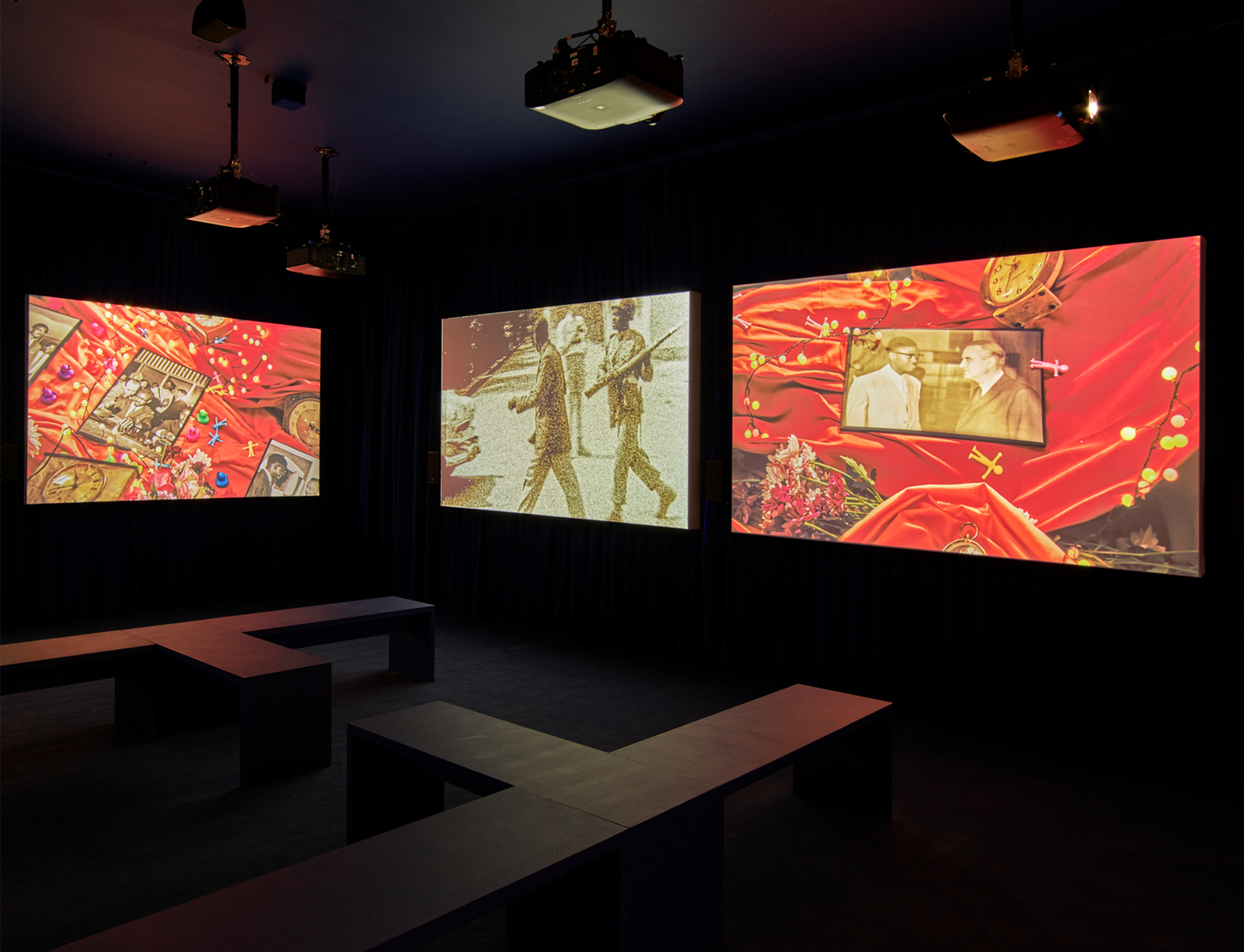
The canto has undergone several transformations since its well-defined emergence in the fourteenth century in Dante’s 'Commedia'. For Dante, the canto functioned as a structural unit within a theological and cosmological narrative journey. Renaissance and early modern epics—Ludovico Ariosto’s 'Orlando Furioso', Torquato Tasso’s 'Gerusalemme Liberata', and Alonso de Ercilla’s 'La Araucana'—retained the canto as a division within an expansive heroic narrative. The decisive shift came in the twentieth century with Ezra Pound. If for Dante the canto organized a coherent story, for Pound it became something else: a fragmentary unit, a collage, a container for history, economics, myth and politics—non-linear, multilingual, discontinuous. The canto shifted from chapter to method, from narrative division to modernist laboratory for marshalling civilization in fragments. In 'Listening All Night To The Rain', Sir John Akomfrah presents the US premiere of the critically acclaimed eight-canto work first unveiled at the British Pavilion during the sixtieth Venice Biennale. For its New York presentation, Akomfrah introduces a focused iteration of the project, debuting the central multi-channel film, 'Canto VI' (2024), and reshaping the work’s structural inheritance into a cinematic experience tailored to this context. Rather than revive Dante’s narrative project, he adopts Pound’s modular logic and retools it for multi-screen installation. Here, the canto becomes an audiovisual vessel organizing colonial archives, diasporic memory, Black Atlantic and climate histories. Across these transformations, the ambition remains to hold disparate histories in relation and to make fragments cohere without erasing their fracture. What follows is a conversation about how such fragments are gathered, structured, and set in motion.
Sabo Kpade (Rail): I’d like to start with a question about the lineage of the cantos. I’ve heard you speak admiringly about Ezra Pound’s 'The Cantos' and the Italian and Spanish tradition of epic poetry. So my question is, just how useful is this literary lineage when you’re shaping a work such as 'Listening All Night To The Rain?'
John Akomfrah: Well, the question of a literary shadow is literally that—it’s always there. Another way of considering it would be to think about the relationship between improvisation and a harmonic scale. I am aware of it, but I’m not drawing on it. There’s no obvious causality between the two. I’m not trying to do an Ezra Pound canto. I’m not even trying to emulate it, but it is a kind of charismatic presence. It’s something to be in conversation with. I’m not talking about his politics or ethics. I’m talking about the stylistic moves that he makes. I am interested in the seamless way in which he moves from one obsession to the next, from a kind of economic remuneration to a political one to a philosophic one—he moves effortlessly between subject matters and between centuries. There’s a kind of erudition to Pound, a well-learnedness, and when you’re in your sixties, you think, “Well, maybe I should aspire to that”—not that you necessarily make it. [Laughter] So it’s not an imitation, it’s not a mimicry. It’s not even an attempt to draw directly from what he’s done. It’s just to keep a kind of sense of affinity with him going.
Read the full interview by Sabo Kpade for The Brooklyn Rail here.
Image: Installation view: John Akomfrah: Canto VI, Lisson Gallery, New York, 2026. © Smoking Dogs Films. Courtesy Smoking Dogs Films and Lisson Gallery.