‘Everything is Sculptural’: Interview with Tony Cragg at Lisson Gallery, London – Whitehot Magazine
2 December 2025
“Without material, there is nothing.” These powerful words, shared by Tony Cragg during our interview, encapsulate the very essence of his sculptural process. Embracing materiality, molecular interconnectivity and sculptural motion, Tony Cragg’s solo exhibition at the Lisson Gallery, London, is a tribute to material. Centred around three significant series, Path, Incident and Stand, this exhibition showcases the rhythmic, organic and even choreographic potential of sculpture. In works like REM, Cragg’s handling of steel transgresses a legacy of sculptural formalism. Instead, Cragg grants his material agency. They adopt fluid forms that unravel, undulate and coalesce – confronting stasis through their dynamism. Yet, it is in the heart of the exhibition where Cragg's sculptural dance comes to life. Emerging from the ground, works like All Shook Up and Recall ripple and flow endlessly. As you pass through the space, their movement becomes all-encompassing. These sculptural bodies dance around each other, performing their routine. Navigating the gallery, it feels as if we, the spectators, become swept up in Cragg’s choreography. I spoke with Cragg about his fierce espousal of materialism and his rejection of 'stuff', how his course of forms has a synonymity with dance, and the congruity he recognises in our material foundations.
Palmer: This solo exhibition at the Lisson Gallery is centred around the latest additions to your Incident, Path and Stand sculptures. What is it about these series that keeps drawing you back to them? Why were these sculptures the ones you chose to return to for the Lisson exhibition?
Cragg: The point of the exhibition is that I wanted to return to this gallery, where I've exhibited since 1979, to continue a dialogue with those interested in my work. It's more or less an exhibition of the work’s development since the last exhibition, five years ago. That's where it really begins. Incident was, and is, an exciting way of working. Steel sculpture is historically quite new, as bronze has always been easy to manipulate. It's soft, with a low melting temperature. You can do a lot of stuff with it to make polymorphic forms. But steel, as the word says, is the strong one. It’s a turgid liquid when molten, with a much higher melting temperature. That’s why you don’t get people readily melting down steel. You need industrial things to do it. It's very difficult to work with, but it’s incredibly strong. So, although many of the larger classical sculptures are bronze, they're full of steel inside.
Having looked at steel sculpture for many years, I became aware of the high beams and steel plates used by sculptors. That history passes through Eduardo Chillida to Mark di Suvero, through Anthony Caro, making steel sculptures that are always very constructive. It’s usually these men, welding away, and I just thought what I wanted to do was to construct sculptures in this strong material, where you can expect more poise and position in space. By stressing the material, you could have a more organic or even lyrical quality. So Incident was fantastic because I carved them in polyurethane, a tough material that I can carve very precisely. Then, after I've carved the thing, it gets cast in steel. By doing this, it transfers that lightness of balance and poise from the soft material into the steel sculptures.
Read the full article by Grace Palmer for Whitehot Magazine here.
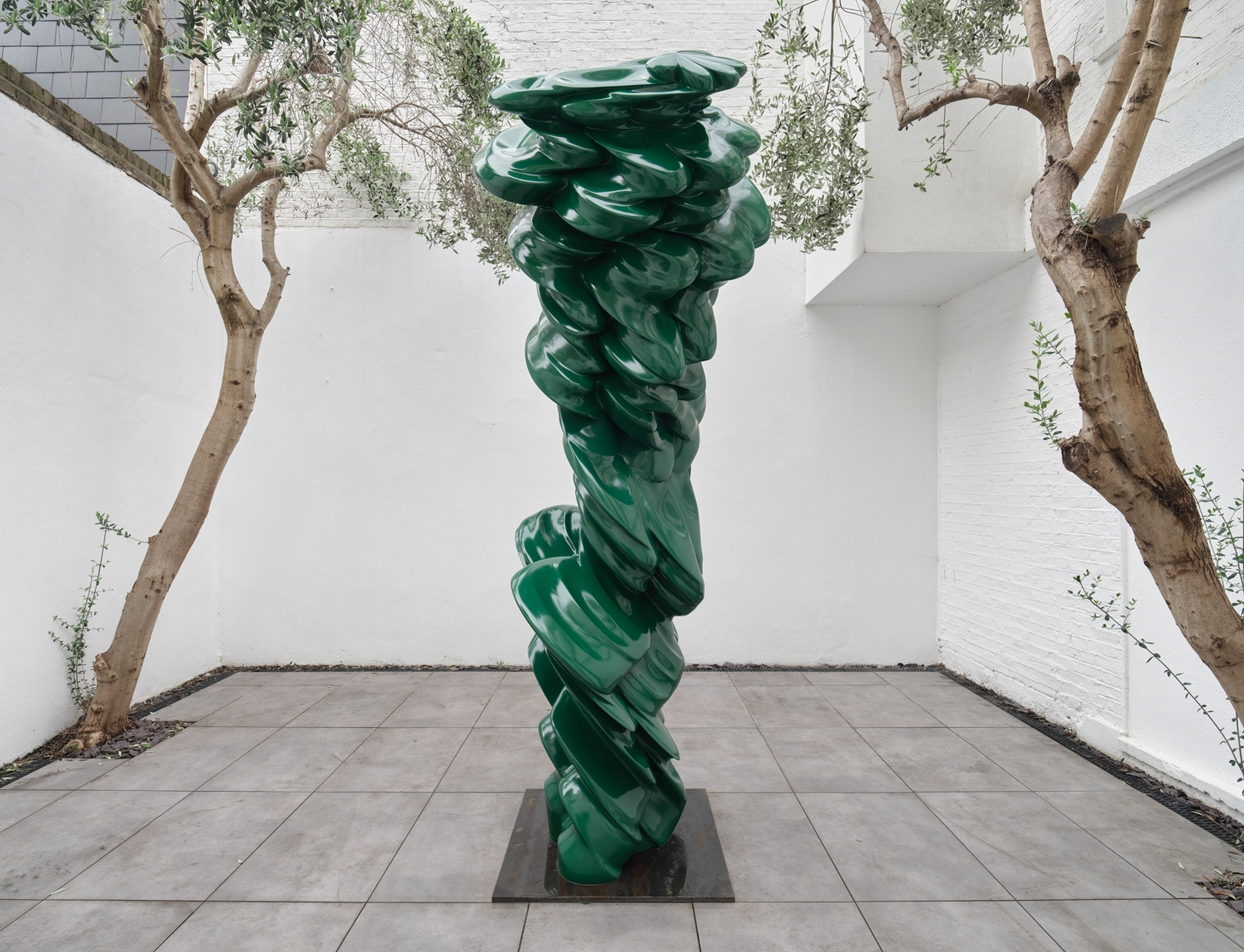
Image: Tony Cragg, Contradiction, 2024, Bronze, 340 x 117 x 131 cm, 133 7/8 x 46 1/8 x 51 5/8 in © Tony Cragg, Courtesy Lisson Gallery